Skip to content
LogoTechnipages
LogoTechnipages
  • Topics
        • Android
        • Browsers
        • Gaming
        • Hardware
        • Internet
        • iPhone
        • Linux
        • macOS
        • Office
        • Reviews
        • Software
        • Windows
        • Definitions
        • All Recent Posts
  • Product Reviews
  • About

How to Change the Default File Type in Word

Mel HawthorneSeptember 11, 2020 Comments (0)

Most users of Microsoft Word will be perfectly happy with saving all their documents in the default “docx” file type and perhaps occasionally exporting a document as a PDF. In work environments, however, there may be times where you may need to use one of the alternative file type options that Word can save in.
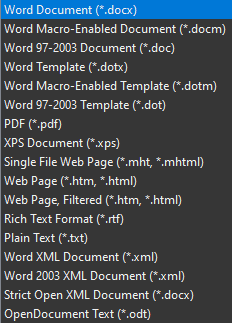
Microsoft Word can save documents in seventeen different file types.

If you only need to use these alternative file type options occasionally, you’ll likely be perfectly happy just changing the file extension when you go to save the document. If you primarily need to save Word documents using an alternative file type however, you may want to change the default file type, to save yourself the time of manually changing it so often.

How to change the default file type in Word

You can configure the file type that Word saves documents in by default, by opening Word’s options. To do so, click “File”, in the top-left corner, then click “Options” in the bottom-left corner.
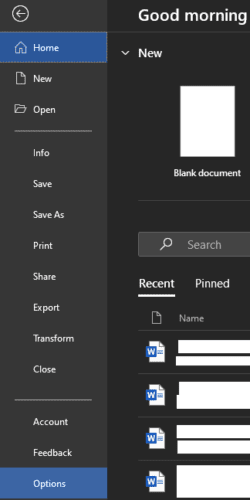
Click “File”, in the top-left corner, then click “Options” in the bottom-left corner to open Word’s options.

Once in the options menu, switch to the “Save” tab, and click on the first drop-down box, labelled “Save files in this format”. Here you can select the file type that you want to be the default file type for newly saved documents. Once you’ve picked the format you want, click “OK” to save the change.

Tip: You should be aware that not all file types will support all of Word’s features. For example, the older “doc” file type doesn’t support all of the features that “docx” does, so your saved document may not retain all functionality. Additionally, not all file types will even be editable. For example, Word can’t open and edit PDF documents directly, it has to convert the file first, a process that isn’t perfect and can lose some formatting details.
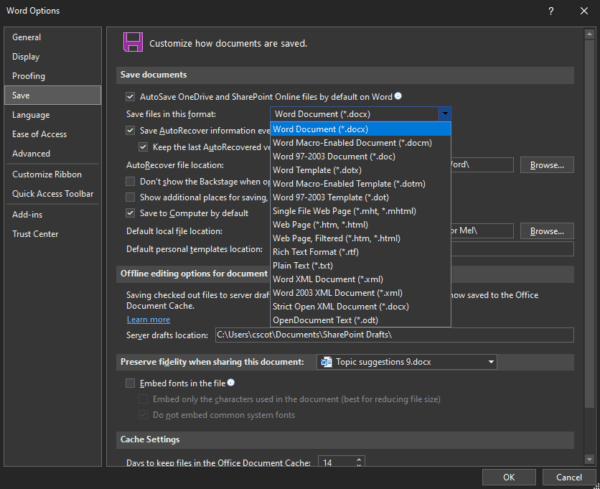
In the Save tab, select a new default file type from the “Save files in this format” drown-down box.

Categories: Office

Author Mel Hawthorne

You Might Also Like

  • troubleshoot Powerpoint file saving errors

    Troubleshooting Powerpoint Not Saving Files

    Madalina DinitaOffice
  • Outlook Get Add-ins Button Is Grayed Out Top 5 Solutions in 2023

    Outlook Get Add-ins Button Is Grayed Out: Top 5 Solutions in 2023

    Tamal DasOffice
  • Outlook Email View Changed The 5 Best Ways to Fix It

    Outlook Email View Changed: The 5 Best Ways to Fix It

    Susan SheffieldOffice
  • How to Use Excel IF-THEN Formula 5 Best Real-World Scenarios

    How to Use Excel IF-THEN Formula: 5 Best Real-World Scenarios

    Susan SheffieldOffice

Leave a Reply

Your email address will not be published. Required fields are marked *

  • clipchamp unexpected application error

    Clipchamp Unexpected Application Error: Here’s the Solution 

  • winload.efi file missing error

    Winload.EFI File Missing Error on Boot – How to Fix

  • fix error 0x9cfc7550

    How to Fix Error 0x9cfc7550 (We Couldn’t Create a New Partition) in Windows 

  • fix error code 0x3000008 1

    How to Fix Error Code 0x3000008 for Remote Desktop Connection

  • fix error code 0x80190001 1

    How to Quickly Fix Error 0x80190001 for Microsoft or Outlook Account Login 

profile pic

The Experts Behind Technipages

My name is Mitch Bartlett. I've been working in technology for over 20 years in a wide range of tech jobs from Tech Support to Software Testing. I started this site as a technical guide for myself and it has grown into what I hope is a useful reference for all.

Learn More

technipages logo white
linkedin icon

Technipages is part of Guiding Tech Media, a leading digital media publisher focused on helping people figure out technology. Learn more about our mission and team here.

© 2025 Guiding Tech Media All Rights Reserved

  • About Us
  • Contact
  • Terms of Use
  • Privacy Policy

© 2025 Guiding Tech Media All Rights Reserved

Information from your device can be used to personalize your ad experience.
Do not sell my personal information.

Last Updated on September 11, 2020 by Mitch Bartlett