

Skip to content
LogoTechnipages
LogoTechnipages
  • Topics
        • Android
        • Browsers
        • Gaming
        • Hardware
        • Internet
        • iPhone
        • Linux
        • macOS
        • Office
        • Reviews
        • Software
        • Windows
        • Definitions
        • All Recent Posts
  • Product Reviews
  • About

Zoom: How to Hide Call Participants Who Aren’t Using a Webcam

Mel HawthorneJanuary 4, 2021 Comments (0)

Due to the increase in remote working caused by Covid-19 related travel restrictions, Zoom has seen a huge increase in usage. A big part of this increase in popularity has been from businesses that use it to conduct digital “face-to-face” meetings, rather than just using phone calls. While Zoom defaults to using the “Active Speaker” view that prioritizes the video window of the person who’s currently speaking, in large meetings you may prefer to use the “Gallery” view.

The “Gallery” view allows you to see everyone’s video feed at the same time, with up to forty-nine video feeds tiled in one screen, and any further participants shown on a second screen. One of the things that you may notice in the “Gallery” view is that some users may not have their webcam video enabled. This could be because they don’t want to enable their webcam at the moment or because they don’t have one at all for example. These users with no video feed will take up spaces in your “Gallery” view with a black box that contains their name, which could be better used by users with their webcams enabled.

Zoom offers an option to hide the users that don’t have their webcam video enabled, you can enable this option in Zoom’s settings. To access the settings, click on your user icon in the top-right corner, then click on “Settings”.

To access Zoom’s settings, click on your user icon, then on “Settings” in the dropdown menu.

Once in the settings, switch to the “Video” tab, then scroll down and tick the checkbox labelled “Hide non-video participants”. This setting will apply to all future and any current meetings when changed.

If you just want to quikcly enable the feature for a meeting you’ve already joined, you can right-click on a user’s feed and select “Hide non-video participants” from the dropdown menu.
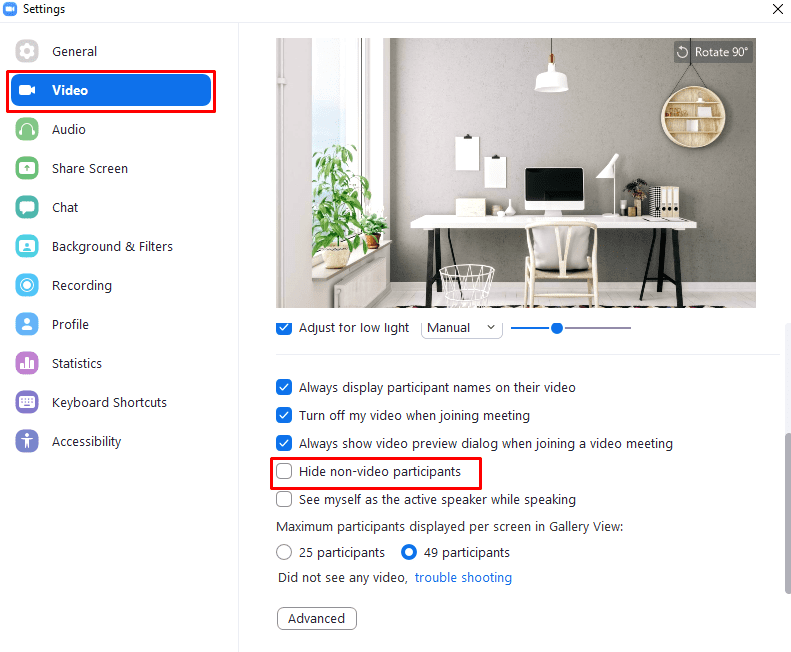
Enable “Hide non-video participants” in the “Video” settings.

Categories: Internet | Software

Author Mel Hawthorne

You Might Also Like

  • 7 Chrome Extensions to Make Gmail More Productive

    Judy SanhzInternet
  • Slack: How To Configure How People Can Join a Workspace

    Mel HawthorneInternet
  • Slack: How To Configure the Workspace To Display Users Full Names

    Mel HawthorneInternet
  • Bitwarden: How to Unlock the Browser Extension with a PIN or Biometrics

    Mel HawthorneInternet

Leave a Reply

Your email address will not be published. Required fields are marked *

  • system32 folder opens on startup

    System32 Folder Opens on Startup – How to Fix

  • browser keeps opening hp support

    Browser Keeps Opening HP Support Assistant Tabs 

  • camera not working in vmware

    Camera Not Working in VMware – How to Fix

  • browser screen goes black

    Browser Screen Goes Black Intermittently 

  • computer heating up in hyper v

    Computer Heating Up When Using Hyper-V – How to Fix 

profile pic

The Experts Behind Technipages

My name is Mitch Bartlett. I've been working in technology for over 20 years in a wide range of tech jobs from Tech Support to Software Testing. I started this site as a technical guide for myself and it has grown into what I hope is a useful reference for all.

Learn More

technipages logo white
linkedin icon

Technipages is part of Guiding Tech Media, a leading digital media publisher focused on helping people figure out technology. Learn more about our mission and team here.

© 2026 Guiding Tech Media All Rights Reserved

  • About Us
  • Contact
  • Terms of Use
  • Privacy Policy

© 2026 Guiding Tech Media All Rights Reserved

Information from your device can be used to personalize your ad experience.
Do not sell my personal information.

Last Updated on January 4, 2021 by Mitch Bartlett