Skip to content
LogoTechnipages
LogoTechnipages
  • Topics
        • Android
        • Browsers
        • Gaming
        • Hardware
        • Internet
        • iPhone
        • Linux
        • macOS
        • Office
        • Reviews
        • Software
        • Windows
        • Definitions
        • All Recent Posts
  • Product Reviews
  • About

What Is Colour Depth and How Does It Affect Image Quality?

Mel HawthorneJuly 22, 2020 Comments (0)

The most commonly advertised feature of a monitor, image, or video is the resolution or the refresh rate. These aren’t, however, the only factors in image quality. Another key feature in image quality is colour depth.

What does colour depth mean?

Colour depth is measured in bits and describes the number of bits that are used to display the colour of each pixel. Bits work in binary, so for each extra bit, the number of supported colours is doubled.

In a one-bit image, there are only two possible colours, in a 2-bit image there are four colours, a four-bit image has sixteen colours and so on. The standard image, video and display format in 2020 is the 24-bit “True colour” format, it is used in almost all devices and codecs.

True colour has 8 bits of data for each of the red, green and blue pixels. Overall, there are 2­24, or 16,777,216 colours that can be displayed with 24 bits. This is considered true colour as the human eye is only able to discern around ten million colours.

Tip: A few codecs will support 32-bit colour; however, the extra 8 bits are only used as an “alpha” or transparency channel and don’t really add any “new” colours we could see.

Issues with the RGB colour space

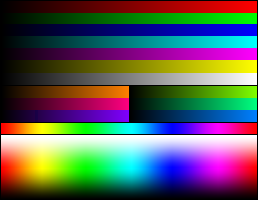
The design of the RGB colour space as used by most devices doesn’t evenly distribute colours that can be perceived by the human eye. There are fewer colour options for blues and yellows than there are for reds and greens, so people are more likely to notice a banding effect with those colours.

Tip: Banding happens when colours that should be separate ‘melt’ together into a tone that isn’t quite right because there aren’t enough tones available to display things right. This can also be caused by strongly compressing files, and it displays as a jagged edge or spots on an image.

When showing blacks and greys, the RGB colour space sets all three colours to the same value, meaning there are only 256 shades of grey. This makes it more likely to spot banding issues in shadows and darker images.

On the left: Banding.
On the right: Smoothed out shades of grey.

Compression algorithms generally reduce the colour accuracy in their effort to reduce the amount of space an image uses – so they remove colours that are unlikely to be used or are easy to replace – but if too much is removed, the picture will show a banding effect.

Categories: Hardware

Author Mel Hawthorne

You Might Also Like

  • Oculus

    VR Oculus Quest 2: How to Play Steam Games

    Mel HawthorneGaming
  • 3D printing header

    3D Printing: Troubleshooting Resin Prints Not Printing

    Mel HawthorneHardware
  • If you are restarting your phone after running in safe mode

    What Is Safe Mode on Android and What You Can Do

    Judy SanhzHardware

Leave a Reply

Your email address will not be published. Required fields are marked *

  • hard disk smart command error

    Hard Disk SMART Command Failed – How to Fix 

  • files automatically deleted on click

    Files Getting Deleted Automatically? Here Are Some Reasons Why

  • error 400 when signing in

    Encountered Error 400 When Signing In to Microsoft? Here’s What You Can Do 

  • unable to create notebook error in onenote

    We Were Unable to Create Your Notebook Error in OneNote – Common Fixes 

  • error code 0x800704f8 fix

    Error Code 0x800704f8 – How to Fix 

profile pic

The Experts Behind Technipages

My name is Mitch Bartlett. I've been working in technology for over 20 years in a wide range of tech jobs from Tech Support to Software Testing. I started this site as a technical guide for myself and it has grown into what I hope is a useful reference for all.

Learn More

technipages logo white
linkedin icon

Technipages is part of Guiding Tech Media, a leading digital media publisher focused on helping people figure out technology. Learn more about our mission and team here.

© 2026 Guiding Tech Media All Rights Reserved

  • About Us
  • Contact
  • Terms of Use
  • Privacy Policy

© 2026 Guiding Tech Media All Rights Reserved

Information from your device can be used to personalize your ad experience.
Do not sell my personal information.

Last Updated on July 22, 2020 by Mitch Bartlett