

Skip to content
LogoTechnipages
LogoTechnipages
  • Topics
        • Android
        • Browsers
        • Gaming
        • Hardware
        • Internet
        • iPhone
        • Linux
        • macOS
        • Office
        • Reviews
        • Software
        • Windows
        • Definitions
        • All Recent Posts
  • Product Reviews
  • About

How to Manage Your Signed-in Devices on Netflix

Mel HawthorneSeptember 25, 2020 Comments (1)

Many people access their Netflix account across multiple devices. A smart TV is ideal for access from home, while laptops, tablets, and phones are suited to usage while on the go. Lots of people even share access to their account with their family to help cut down on costs.

Occasionally it’s good to check to see what devices are signed in to your account, just to make sure that no one is accessing your account that shouldn’t be. To do so, you need to first sign into Netflix on a computer. You can then access your account details, by choosing a user profile, then clicking the profile icon in the top-right corner, then clicking “Account”.

Click on your profile icon in the top-right corner then select “Account”.

How to manage your signed-in devices

In the account page, there are three options useful for managing your devices, all of which are located in the “Settings” sub-section. You’ve got “Manage download devices”, “Recent device streaming activity”, and “Sign out of all devices”.
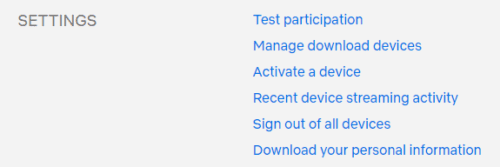
There are three helpful device management settings in the “Settings” sub-section.

The “Manage Download Devices” page allows you to review which devices currently have downloaded content saved, when they last downloaded content, and what shows and episodes they have downloaded.

If you want to download content to another device but can’t because too many devices already have content, you can remove a device here. Removing a device, won’t kick it from your account, instead, next time, it connects to Netflix, the downloads will be marked as expired.

To remove a device, simply click the relevant “Remove device” button. Once you’ve done so you can start downloading content to a new device.
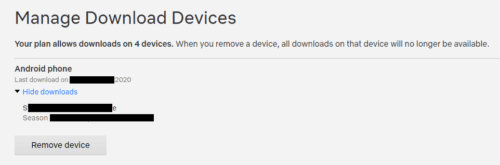
Review the devices that have downloaded content and clear them by clicking the relevant “Remove device” button.

In the “Recent device streaming activity screen”, you can see the locations from which your account has streamed content from, and a rough description of what device was used. Reviewing this activity log can help you see if someone has accessed your account without authorisation. Unfortunately, you can’t specifically sign a single suspicious device out.
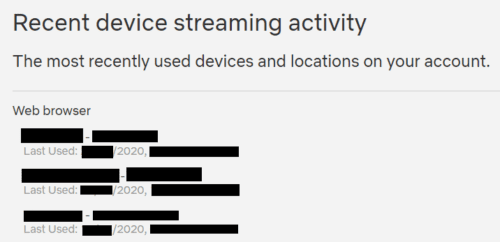
Review the locations and times of activity on your account to ensure it’s not been accessed without authorisation.

The “Sign Out of All Devices” page, allows you to sign every device out of your account, by clicking the “Sign out” button.

Note: This process can take up to eight hours to take effect.

This option is useful if you’ve noticed suspicious activity on your account and want to sign everyone out and change your password. Unfortunately, it only applies to all devices rather than being able to target specific suspicious sessions.

You can sign all devices out of your account if you feel that your account may have been compromised.

Categories: Internet

Author Mel Hawthorne

You Might Also Like

  • Twitter Setting Causes Missing Tweets

    Mitch BartlettInternet
  • Google Duo: How To Configure Which Audio or Video Devices You Use

    Mel HawthorneInternet
  • Slack: How To Disable Public File Sharing

    Mel HawthorneInternet
  • facebook how to hide who you follow

    How to Hide Who You’re Following on Facebook

    Madalina DinitaInternet

Comments

  1. Patti says:
    August 3, 2022 at 4:15 pm

    i have to sign in every time we watch Netflix on all devices! Help!

Leave a Reply

Your email address will not be published. Required fields are marked *

  • winload.efi file missing error

    Winload.EFI File Missing Error on Boot – How to Fix

  • fix error 0x9cfc7550

    How to Fix Error 0x9cfc7550 (We Couldn’t Create a New Partition) in Windows 

  • fix error code 0x3000008 1

    How to Fix Error Code 0x3000008 for Remote Desktop Connection

  • fix error code 0x80190001 1

    How to Quickly Fix Error 0x80190001 for Microsoft or Outlook Account Login 

  • fix filecoauth.exe application error

    Fix FileCoAuth.exe Application Error 

profile pic

The Experts Behind Technipages

My name is Mitch Bartlett. I've been working in technology for over 20 years in a wide range of tech jobs from Tech Support to Software Testing. I started this site as a technical guide for myself and it has grown into what I hope is a useful reference for all.

Learn More

technipages logo white
linkedin icon

Technipages is part of Guiding Tech Media, a leading digital media publisher focused on helping people figure out technology. Learn more about our mission and team here.

© 2025 Guiding Tech Media All Rights Reserved

  • About Us
  • Contact
  • Terms of Use
  • Privacy Policy

© 2025 Guiding Tech Media All Rights Reserved

Information from your device can be used to personalize your ad experience.
Do not sell my personal information.

Last Updated on September 25, 2020 by Mitch Bartlett