
Skip to content
LogoTechnipages
LogoTechnipages
  • Topics
        • Android
        • Browsers
        • Gaming
        • Hardware
        • Internet
        • iPhone
        • Linux
        • macOS
        • Office
        • Reviews
        • Software
        • Windows
        • Definitions
        • All Recent Posts
  • Product Reviews
  • About

What is GDDR6X?

Mel HawthorneSeptember 17, 2020 Comments (0)

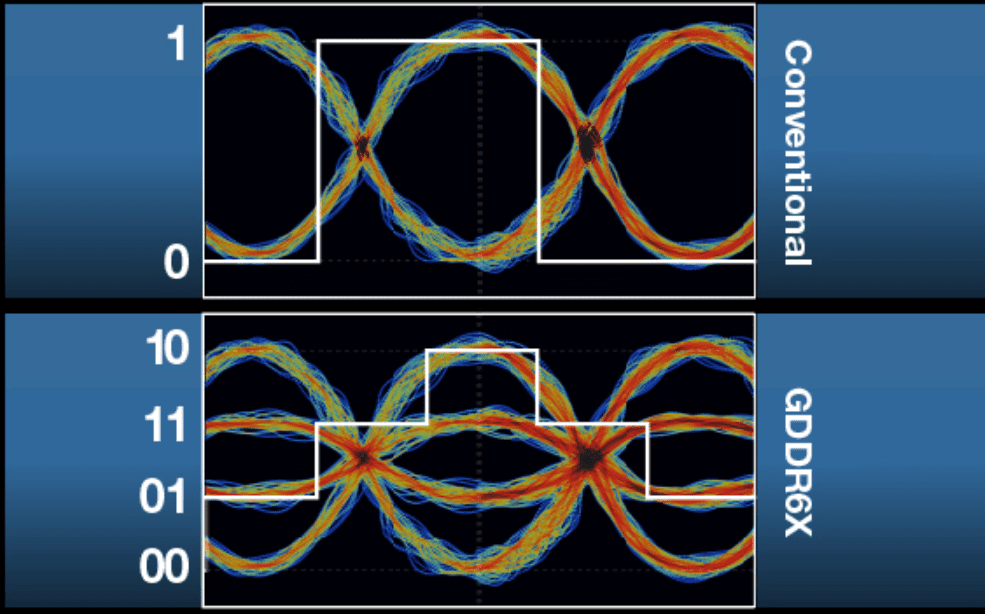
With Nvidia’s announcement of its 3000 series RTX graphics cards, gamers were introduced to a new type of graphics memory, GDDR6X. GDDR6X memory comes with a revolutionary design that significantly increases the data transfer speed. The new feature is called PAM4 or Pulse Amplitude Modulation 4.

Traditionally the transmissions to and from memory operate in a system with two power levels 1 and 0. PAM4 revolutionises memory communications by using four power levels allowing for double the amount of data to be sent with each cycle. Traditionally there are two power levels, with one transmitting a binary 0 and the other transmitting a binary 1. PAM4’s four levels allow it to transmit one of four signals, 00, 01, 10, and 11.

In terms of power efficiency, GDDR6X memory uses 15% less power per bit of data transferred than GDDR6 memory. This is despite GDDR6X having 50% extra bandwidth compared to GDDR6. The disparity between bandwidth increases and power efficiency improvements, however, means that overall power requirements have increased.

In order to keep power requirements reasonable and to simplify the complexities of the first generation of PAM4 memory controllers, GDDR6X memory operates at lower clock speeds than earlier GDDR6 memory. The reduced clock speed means that GDDR6X only sees a 50% increase in memory bandwidth rather than a 100% increase. This does help keep costs and thermals down though. Future generations of GDDR6X memory are likely to see further performance advances

Each 8Gb (1GB) chip of GDDR6X memory has the bandwidth to transfer 84GB/s. This means that Nvidia’s RTX 3080 graphics card, which has 10 GDDR6X chips, will have a total memory bandwidth on the order of 840GB/s

Micron, the developer and manufacturer of the GDDR6X memory has pushed the boundaries of what can be done with memory. As of September 2020, it’s not clear if Micron has developed this memory on its own or if JEDEC is in the process of creating a standard and Micron just jumped the gun.


Categories: Hardware

Author Mel Hawthorne

You Might Also Like

  • Moto360 Rumors and Speculation

    MonaHardware
  • Game Controller

    How to Troubleshoot an Xbox One Controller on PC

    Mel HawthorneGaming
  • Slack: How To Change When Channels Are Marked as Read

    Mel HawthorneHardware

Leave a Reply

Your email address will not be published. Required fields are marked *

  • browser keeps opening hp support

    Browser Keeps Opening HP Support Assistant Tabs 

  • camera not working in vmware

    Camera Not Working in VMware – How to Fix

  • browser screen goes black

    Browser Screen Goes Black Intermittently 

  • computer heating up in hyper v

    Computer Heating Up When Using Hyper-V – How to Fix 

  • clipchamp unexpected application error

    Clipchamp Unexpected Application Error: Here’s the Solution 

profile pic

The Experts Behind Technipages

My name is Mitch Bartlett. I've been working in technology for over 20 years in a wide range of tech jobs from Tech Support to Software Testing. I started this site as a technical guide for myself and it has grown into what I hope is a useful reference for all.

Learn More

technipages logo white
linkedin icon

Technipages is part of Guiding Tech Media, a leading digital media publisher focused on helping people figure out technology. Learn more about our mission and team here.

© 2025 Guiding Tech Media All Rights Reserved

  • About Us
  • Contact
  • Terms of Use
  • Privacy Policy

© 2025 Guiding Tech Media All Rights Reserved

Information from your device can be used to personalize your ad experience.
Do not sell my personal information.

Last Updated on September 17, 2020 by Mitch Bartlett